About the The Social Rights Monitor
The Social Rights Monitor (SRM) is SOLIDAR’s annual assessment of how the principles of the European Pillar of Social Rights (EPSR) are being implemented at national level, from the perspective of civil society organisations active on the ground.

The Social Rights Monitor (SRM)
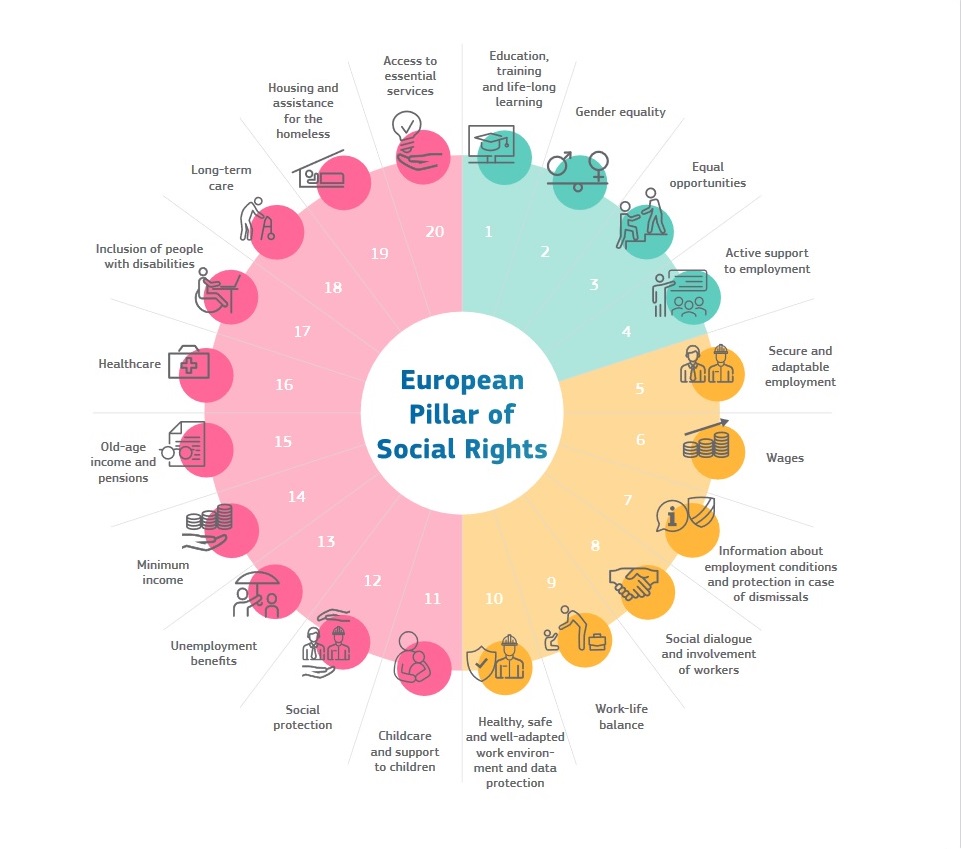
The EPSR is a set of 20 principles that guide the action of the European Union in the realm of social policy. In other words, it is intended to be a compass guiding the EU towards a more social Europe. For too many people in Europe, however, the social rights enshrined in the Social Pillar are not yet a reality. Thanks to the contribution of our members and their networks on the ground (the National Strategy Groups), SOLIDAR monitors the extent to which social rights are respected, upheld and promoted for all people living in the EU.
The Social Rights Monitor also investigates the health of civic space and social and civil dialogue in the EU, as well as the extent to which a just transition is being pursued. Therefore, the thematic areas covered by the Monitor are the following: Equal opportunities and access to the labour market; Fair working conditions; Social inclusion and protection; a Just transition; and Civic space. The first three correspond to the three chapters of the EPSR, while the last two have been added to give a fuller picture of social justice in Europe.
Why it matters
Lorem ipsum dolor sit amet, consectetur adipiscing elit. Curabitur quis tristique mauris. Aenean et accumsan enim, volutpat lobortis augue. Aenean luctus blandit mollis. Pellentesque eleifend id nibh eu tincidunt. In sagittis accumsan dapibus. Nulla sit amet commodo neque, iaculis faucibus dolor. Nam imperdiet sapien nulla, non vehicula risus dapibus at. Cras sed luctus mi.
Nullam tincidunt lorem eget lacus pellentesque finibus. Praesent porttitor ex ex, in pharetra velit fringilla sit amet. In euismod pretium massa, at fringilla erat fermentum non. Suspendisse potenti. Etiam neque magna, interdum eget condimentum eu, vulputate vestibulum dui. Donec euismod, dui non lacinia pharetra, arcu neque facilisis est, faucibus suscipit ante nulla ac nisl. Suspendisse potenti. Quisque sit amet iaculis mi.

Partners
Built on the expertise and lived experience of SOLIDAR’s members and partners, the SRM captures recent policy developments that affect people’s social rights, civic participation, and the transition towards a sustainable economy. Rather than measuring social conditions in absolute terms, the Monitor highlights short-term trends, identifying improvements, stagnation, or deterioration over the past 12 months.




Understanding the The Social Rights Monitor Methodology

Higher scores reflect improvements over the past year, lower scores reflect deteriorations.
The Social Rights Monitor (SRM) is based on first-hand qualitative and quantitative information collected from national civil society organisations. Data are gathered by SOLIDAR’s secretariat through a structured questionnaire sent to the leaders of the National Strategy Groups (NSGs), who complete it using evidence, expertise, and inputs from their national networks. Since 2023, the questionnaire has been conducted online. NSGs assess national developments related to social rights, civic space, and the just transition by responding to a series of Likert-scale questions. For each thematic area, the responses are aggregated and converted into a score out of 100. Lower scores correspond to negative developments, while higher scores indicate positive developments over the reporting period. Each country receives a score for every thematic area, and the overall national score is calculated as the average of these thematic scores.
The SRM relies on the analysis and contextual knowledge of civil society actors on the ground. In addition to scoring developments, NSGs provide qualitative information and policy analysis. Based on the results, SOLIDAR and the NSGs jointly formulate policy recommendations addressed to EU policymakers. These “advocacy messages” aim to strengthen social rights, promote a just transition, and safeguard an enabling and protected civic space across Europe. The SRM is published annually, typically at the end of November or the beginning of December. Each edition covers developments occurring between June of the previous year and May of the publication year, reflecting the timing of questionnaire submissions by NSGs at the end of May.
Categories
Non-traditional learning gained momentum in 2024, with more policy support and recognition, alongside lifelong learning initiatives for green-economy skills.
Key progress:
- Vocational and dual-model education expanded across Europe, with Serbia, Spain, and Bulgaria leading the way.
- The importance of STEM education is growing, and its promotion is accelerating alongside lifelong learning initiatives for green-economy skills.
Key setbacks:
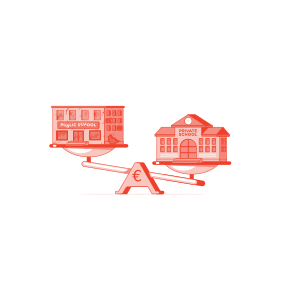
- Public schools remain under-resourced while private institutions become more elitist.
- Student segregation, academic and social, persists across European education systems, including in France, Greece and Serbia.
Persistent gender pay gaps, limited childcare, and cultural care expectations continue to hinder women’s employment. In all the monitored countries, women are underrepresented in higher-paying and decision-making roles.
Key progress:
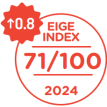
- The EU scored 71 out of 100 in the 2024 EIGE Gender Equality Index, a 0.8-point rise from 2023.
- According to the Index, the EU improved most in power (+ 2.3 points), driven by improvements in the sub-domains of economic power (+2.9) and social power (+2.5).
Key setbacks:
- Gender-based violence has been increasing across Europe, and feminicides reached record highs in Italy and Germany.
- Violence and aggression against LGBTQI+ people are rising.
Migration policy tightened in many EU countries including through illegal practices, while migrants still face discrimination, and barriers to decent work and essential services.
Key progress:
Germany, Slovenia, Serbia, and Croatia made reforms to promote labour migration, regularisation, and fair treatment for foreign workers.
Key setbacks:
Portugal’s transition to the Agency for Integration, Migration and Asylum (AIMA) caused major delays in residence permits.
Greece and Italy have continued illegal practices such as pushbacks and return hubs.
Minimum wages increased across Europe, but often failed to keep pace with inflation, leaving 8.2% of workers at risk of poverty.
Key progress:
- Employment rate reached 75.8% in 2024, a 0.5 percentage point increase from 2023, with growth partially driven by green economy jobs in countries such as Spain.
Key setbacks:
- Temporary and informal contracts persist in low-wage sectors, especially in Southern and Eastern Europe.
- Migrants, women and those in low-income regions remain most affected by pay gaps and wage disparities.

Occupational safety and health (OSH) remain a concern across Europe.
Key progress:
- Albania and Serbia implemented new OSH legislation frameworks.
Key setbacks:
- Kosovo, North Macedonia and Spain still rely on outdated legal frameworks that obscure incident data.
- The proposals to improve or update the frameworks in Kosovo and North Macedonia have either not yet been approved or not yet implemented.

Social dialogue remains uneven across Europe; relatively stable in Central Europe but weak in the Western Balkans.
Key setbacks:
- Tripartite social dialogue institutions in Albania and Kosovo were largely inactive, while no new collective agreements were reached in Serbia.
- Social dialogue remains highly ineffective in North Macedonia.
- 87% share apartments. Economically disadvantaged households, such as those headed by single parents or migrants, also face major challenges.
The financialisation of the housing market has limited the availability of affordable housing. The shortage of social and public housing particularly affects vulnerable groups that cannot afford market prices.
There is a severe housing crisis across Europe, affecting social groups differently.
Key progress:
- The announcement of the European Affordable Housing Plan represents an important opportunity to expand affordable housing and address homelessness and exclusion.
Key setbacks:
- Young people increasingly struggle to access adequate housing, with soaring rents forcing many into shared living; around 70% of Spanish youth rent, and 87% share apartments. Economically disadvantaged households, such as those headed by single parents or migrants, also face major challenges.
- The financialisation of the housing market has limited the availability of affordable housing. The shortage of social and public housing particularly affects vulnerable groups that cannot afford market prices.

Poverty remains a major challenge in Europe, with 21% of the EU population at risk of poverty or social exclusion in 2024. Of the EU’s three headline targets, reducing poverty continues to prove the most difficult.
Key progress:
- France has introduced several projects that facilitate access to benefits.
Key setbacks:
- Rising living and housing costs have hit single parents, migrants, and low-income
- Regional disparities persist, such as in Italy where the poverty rate is 2.5 times higher in the south than the north.
- Civil society in Portugal remains vital in providing welfare services due to lack of adequate public services.

Europe’s green economy has great potential as a contributor to social progress.
Key progress:
- Albania has introduced several initiatives to promote the green economy
- North Macedonia, Serbia and Slovenia, show strong potential for green job and green economy growth.
Key setbacks:
- Although the EU Quality Jobs Roadmap is a welcome proposal, it needs improvement to ensure it is driven by workers and communities, allocates sufficient funds, and fosters just transitions through a lifelong-learning approach.

Access to affordable energy remains a persistent challenge throughout Europe, with 9.2% of EU households unable to adequately heat their homes in 2024, reaching nearly 19% in Bulgaria and Greece.
Key improvements:
- Germany has put in place financial and counselling support to ease energy poverty.
- Bulgaria has developed energy communities under the EU Energy Community Initiative.
Key setbacks:
- High energy costs force many, especially poorer households, to rely on unsafe fossil fuels in inadequate housing.
Civic space in Europe remains under pressure, with several countries classified as “Narrowed” by the CIVICUS Monitor due to restrictions on protests and civil rights, and increasing intolerance toward divergent opinions. CSOs face criminalisation, funding cuts, and limited participation in decision-making.
Key setbacks:
- Excessive force and intimidation against protesters are used un countries like Greece and Serbia.
- Barriers to meaningful civil dialogue discourages CSOs from participating, as seen in Croatia, where public consultation involvement dropped sharply from 2023 to 2024.

Equal opportunities and access to the labour market
This category reflects Chapter 1 of the European Pillar of Social Rights. It analyses the policies and measures put in place by European countries to ensure that marginalised groups have equal opportunities to participate in society, including – but not limited to – access to the labour market. In particular, the Social Rights Monitor assesses:
- Investment in the welfare system
- Gender equality
- Education, training and lifelong learning
- The inclusion of migrants, refugees and asylum seekers and other groups in a vulnerable
- situation
- Quality, renewable work permits for non-EU nationals
- Youth employment
Intersectional perspectives used to assess the impact of policies on marginalised groups, such as gender, are not limited to this section of the Monitor but are integrated throughout the SRM.

Fair Working Conditions
This category reflects Chapter 2 of the European Pillar of Social Rights. Our members and partners report on the quality of jobs and working conditions in their countries. In particular, the Social Rights Monitor assesses:
- Adequate wages
- Job security
- Occupational Health and Safety
- Social and solidarity economy
- Worklife balance
- Social dialogue

Social Inclusion and Protection
This category reflects Chapter 3 of the European Pillar of Social Rights. The objective is to monitor and assess social protection measures put in place at national level and their impact on social protection and inclusion. In particular, the Social Rights Monitor assesses:
- Access to housing
- Poverty eradication
- Access to healthcare
- Access to childcare
- Access to essential services
The assessment of poverty eradication includes the impact of (the lack of) minimum wages and minimum income schemes. In the definition of access to essential services, we include social services, which play a key role in ensuring social justice and cohesion.

Just Transition
At SOLIDAR, we define a “socially just green transition” as placing people and social justice at the heart of climate and environmental policies. In the Social Rights Monitor, we aim to assess the extent to which national measures to enact the green transition also foster social justice, equality, and inclusion.
People in vulnerable situations – due to factors such as socio-economic status, geography, age, and gender – are relatively more exposed to the impacts of climate change and environmental degradation. At the same time, socio-economic inequalities are among the root causes of the climate crisis: richer segments of the population pollute far more than poorer, for example. Therefore, the ecological transition must address environmental, economic, and social issues simultaneously.
There are various social dimensions to the ecological transition. However, for the Social Rights Monitor, we have decided to focus on the following three areas, as their links to social rights are clear:
- Quality of jobs in the green transition
- Access to energy and energy poverty
- Access to sustainable mobility and transport poverty
By quality of jobs, we mean what the ILO refers to as “decent jobs that contribute to preserve or restore the environment”.

Civic Space
In the framework of the Social Rights Monitor, we interpret civic space as an enabling space in which organised civil society and citizens participate in policymaking. They can do this through the following elements:
- An enabling space for civil society organisations
- Involvement of CSOs in civil dialogue
With reference to the second point, we also assess whether civil society is meaningfully involved in the European Semester process. For EU candidate countries, we monitor the involvement of civil society organisations in the accession process and the deriving reforms.
We consider civic space essential to the realisation of a more social Europe. Civil society is vital to democracy and to amplify the voice of the people who are most neglected. The Social Rights Monitor itself is based on the inputs of civil society organisations, and it draws upon their privileged perspectives on the needs of marginalised groups and the state of inclusion at national level.